Fatima
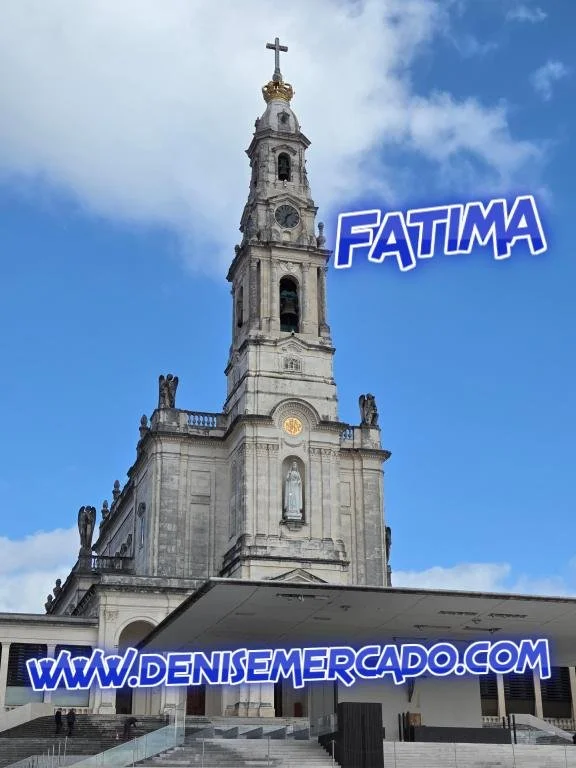
At the very top of my list when planning my trip to Portugal was the Shrine of Our Lady of Fatima. To be sure I did not miss this, I hired a private tour guide when arriving at my hotel in Lisbon. On the designated day, we left the hotel at 8:30am and spent most of the day in Fatima. As we began the journey, the driver mentioned that the name “Our Lady of Fatima” was not the correct name for the apparitions. He gave an explanation which I immediately fact checked.
The name Fatima is of Arabic origin, primarily meaning "one who abstains," "to wean," or "captivating.” It is famously the name of Prophet Muhammad's daughter, Fatima Zahra, symbolizing purity, virtue, and devotion. This name is highly revered in the Muslim world. The town’s name is linked to a 12th-century Moorish princess who converted to Christianity and was renamed Oureana.
The correct name for the Blessed Mother during these apparitions that took place in the town of Fatima is Our Lady of the Rosary. In 1917, the Blessed Mother visited three shepherd children – Lucia dos Santos age 10 and her cousins Francisco Marto age 8 and Jacinta Marto age 7. Each of the apparitions occurred on the 13th of the month, beginning in May with the last apparition in October. During the early apparitions, the Blessed Mother urged prayer, peace, and repentance to end World War I. She also promised a miracle in October which was witnessed by 70,000 people and described as the sun dancing and changing colors.
We began our journey in Fatima at the home of Francisco and Jacinta and the small village where they lived. It was also an honor to meet Jacinta’s brother’s daughter – who is also named Jacinta – see photo in video below!
Before long, we were at the center of the shrine facing the basilica. After instructions from the driver, he left me to explore on my own which is exactly what I prefer.
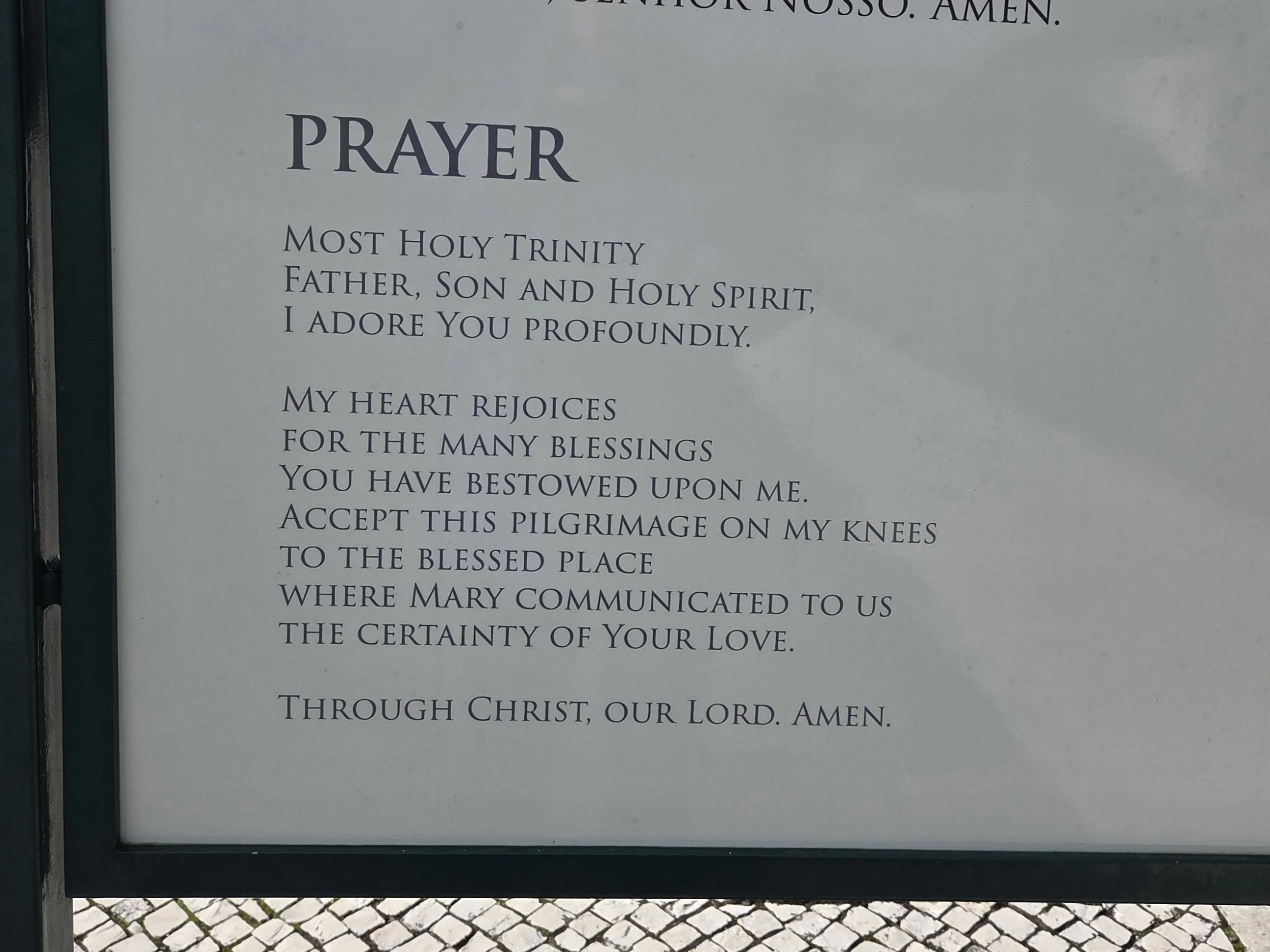
There were several individuals making their pilgrimage on their knees. This is common to see at this shrine. At the end of the pathway was the following prayer.
To be sure I saw everything this shrine had to offer, I started at the right with the Basilica of the Most Holy Trinity. This is a modern basilica with a seating capacity of 8,633. Below this basilica are several chapels including the Blessed Sacrament Chapel and a special area for Confessions. Special signage above the place for Confessions indicated the language preference of the priests. There were a variety of languages offered including English.
A special display had the words Refugio Caminho which in English mean Path of Refuge. This display featured a gallery of beautiful art pieces depicted in the video below.
The next building I explored was the Museum of the Shrine of Fatima. I knew from my research that the museum displayed the Crown of Our Lady which housed the bullet that struck Pope Saint John Paul II on May 13, 1981. The following year, on May 12, 1982, the pope placed the bullet in the crown as a gesture of gratitude for his survival, believing the Blessed Mother guided the bullet. The crown, created in 1942, was made from gold and jewels donated by Portuguese women to thank the Blessed Mother for protecting Portugal during World War II. Miraculously, the bullet fit perfectly into a pre-existing space in the crown underneath the globe and cross at the top, a spot that was not designed for it. You can see the crown and the bullet in the video below.
A beautiful rosary made from the remnants of the Berlin Wall was also on display. Many countries donated gifts to the Shrine. A beautiful gold rosary was displayed as the gift provided by the United States.
There are 13 official statues of Our Lady of the Rosary commissioned by the Sanctuary of Fatima that travel worldwide. These statues are four feet tall and weigh 40 pounds each. Each statue travels with caretakers to various countries spreading the message of peace. One of the 13 statues is part of a special display in the museum at the Fatima shrine.
Several popes also gave special gifts to the shrine in honor of the Blessed Mother. Pope Saint John Paul II donated his papal ring to the Shrine. Also on display were a special rosary made by Sister Lucia for Pope Saint John Paul II. All these beautiful pieces can be seen in the video below.
The walk from the museum to the Basilica of Our Lady of the Rosary included beautiful mosaic artwork along the path. The basilica is the burial place for the three shepherd children. Francisco and Jacinta died in 1920 and were buried in the local parish cemetery. However, Jacinta was moved to the basilica on May 1, 1951. The following year, on March 13, 1952, Francisco was moved to the basilica. A special side altar is dedicated to Francisco. Lucia dos Santos died in 2005 at a convent in Coimbra and was interred at the basilica in February 2006. On the opposite side of the church is the resting place of Jacinta and Lucia.
Another building at the shrine is the Chapel of the Apparitions. This open-air chapel was built in 1919 at the request of the Blessed Mother to mark the spot where she appeared to the three shepherd children in 1917. It was at this location that five of the six apparitions occurred.
Lighting candles in sacred spaces is a common practice. However, I never quite experienced anything like this. It was wonderful to see all the prayers offered to Our Blessed Mother at this shrine.
The video below captures all that I saw at this beautiful shrine. This was the highlight of my trip to Portugal and I am so blessed to have experienced this pilgrimage.
Enjoy the video – there is more to come!
Next blog features a surprise adventure near Fatima.
Stay tuned and remember to leave your book review at the Amazon link below.
God bless all…
Use the Amazon buttons below to order your copy of my latest books. Don’t forget to leave a review on Amazon! Thank you and Happy Reading to ALL…..
For my favorite books by other authors - click here.
God Bless and Remember - Sharing is Caring!